steve jobs


22
Nov 11

Steve Jobs talks PC vs. TV

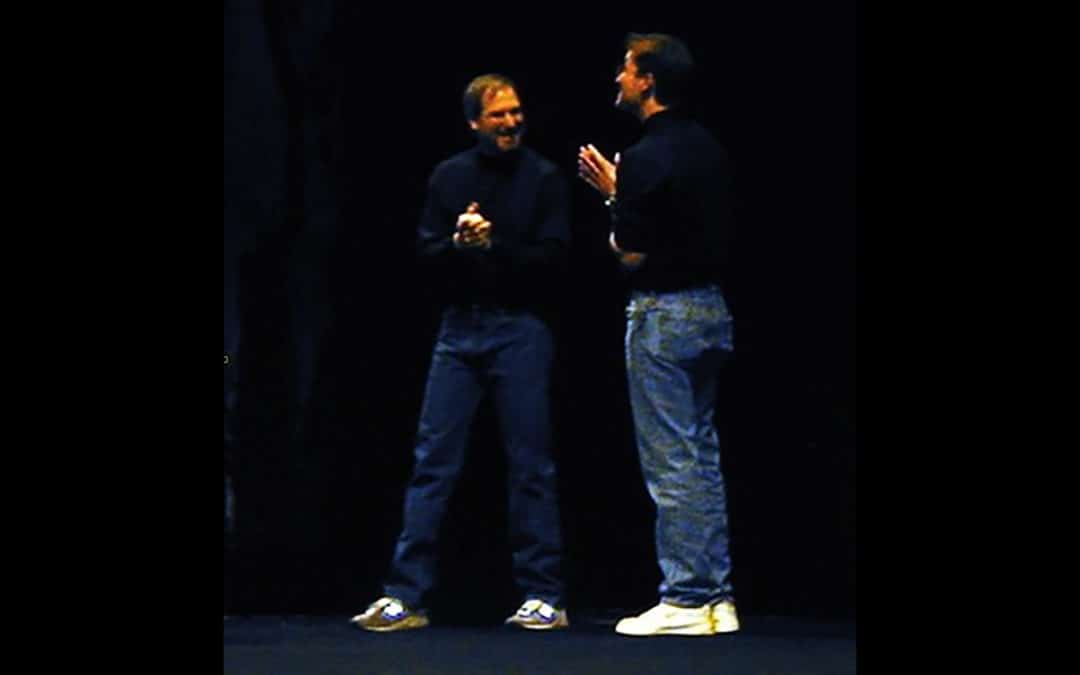
Fortune blogger Philip Elmer-DeWitt uncovered this gem recently — a segment of Steve Jobs’ appearance at the CAUSE 1998 Conference in Seattle.

The video quality is terrible, and the black turtleneck plays second fiddle to a shirt. But the clip is interesting on a few levels.

First, Steve gives one of his more animated performances. At certain points, it’s almost as if he’s trying out a comedy act — and the audience does its part, sounding much like a laugh track. The speech does have substance though. In it, Steve puts television in its place. “TV turns your brain off, PCs turn your brain on,” he says.

Few people would know this, but Steve didn’t exactly pull that thought out of mid-air. He was actually re-purposing the script from an iMac campaign that never saw the light of day.

Right after we signed Jeff Goldblum, we shot a number of iMac commercials in which Jeff repeatedly drove home the point that iMac was for turning your brain on, while TV was for turning your brain off. In one spot, Jeff walked a path littered with old TVs as he spoke. In another, he sat with a bunch of children on the floor, all gathered around an iMac. The theme of the campaign was “iMac. It’s not TV.”

Why did the ads never run? In the end, they just weren’t good enough. Fortunately, on our last shooting day, when we were beginning to feel like we might need a Plan B, we wrote a quick script and shot a test spot featuring Jeff speaking directly to the camera. It worked great. With Steve’s enthusiastic approval, we grabbed a new director and shot the Jeff Goldblum spots that ultimately did run.

I was unaware that Steve had ever used the “brain on, brain off” argument publicly until I saw this video. I’m glad he was able to find a good use for it — especially since it cost him a pretty good chunk of cash.


28
Oct 11

Isaacson: What made Steve Steve

Stop pressuring me. I’m reading as fast as I can.

I have to say, I’m thoroughly enjoying Steve Jobs by Walter Isaacson. Even more impressive than the writing (which is great) is Isaacson’s ability to weave an incredible number of interviews into one coherent story.

I’m not nearly done yet. But what interested me so much in the first half of the book are the early behaviors/experiences that helped form the mature Steve.

Stop here if you don’t want to hear any spoilers.

1. Visiting a dairy farm in Wisconsin, Steve witnessed a newborn calf struggle to its feet. He thought it was remarkable that she was “hardwired” to accomplish this instinctively. Somehow the brain and body were engineered to work together from the start. Ordinarily, I’d say it’s a stretch to tie this to Apple’s hardware and software working together — except that this story comes directly from Steve. The fact that he remembered it so distinctly is interesting, to say the least.

2. Steve’s father taught him a lesson in craftsmanship when they built a fence together, paying attention even to the details that no one would ever see. Many years later, in creating the first Macintosh, Steve demanded that the internal circuit board be better looking, even though no user could ever see it.

3. Of his time in India, Steve observed that the locals used their intuition more than their intellect. Steve said, “Intuition is a very powerful thing, more powerful than any intellect, in my opinion. That’s had a big impact on my work.” I’ll say.

4. Steve was barefoot when he pitched the Apple II to Atari’s president, Joe Keenan. He put his feet up on the desk while they talked and Joe didn’t like it one bit. Some 20 years later, I had the pleasure of seeing the same routine at one of our agency meetings, right there in the Apple boardroom. We weren’t grossed out, but I can’t say I’ve ever seen the bottoms of any other CEO’s feet.

5. In 1981, Steve had a “father figure” in then-CEO of Apple Mike Markkula. Steve said Mike is the one who taught him all about marketing — which is a huge deal, since we all know how Steve’s marketing sense permeates everything Apple does. Mike crafted a one-page paper entitled “The Apple Marketing Philosophy.” Isaacson summarizes its three main points. Empathy: establishing an intimate relationship with the feelings of customers. Focus: eliminating unimportant opportunities so they could do a good job of the things they wanted to do. Impute: ensuring that products are presented in such a way that people perceive quality. The 1981 Apple sounds suspiciously like the 2011 Apple.

6. Steve signed up for a booth at the West Coast Computer Faire, where the Apple II would make its debut. He shocked Woz by paying $5,000 for the best location in the hall, next to the entrance. Woz: “Steve decided that this was our big launch. We would show the world we had a great machine and great company.” Of course, over the years Steve would make sure Apple had a commanding presence at every show — until the company was successful enough that it didn’t even have to show up.

7. Everyone knows about Steve being inspired about the graphical interface and mouse he saw at the Xerox PARC facility. The part I never heard before was that Xerox’s mouse had three buttons and cost $300. Steve went to a local design firm, demanding a single-button mouse that cost $15. Not surprisingly, he got it.

Not that I ever suspected that the modern Steve magically appeared from nowhere — but it’s interesting to see how many of his famous behaviors and beliefs were evident so many years ago.


10
Oct 11

Steve: bringing out the best and worst in us

The outpouring of reactions to Steve’s death has been nothing less than astounding. If you were so disposed — and millions apparently were — you could have spent hours and hours reading the various takes on Steve’s life.

Some are reverential. Some go out of their way to be balanced. Unfortunately, a few live at the intersection of insensitive and clueless.

As someone who worked with Steve, I understand and respect those who point out the two sides of the man. He certainly wasn’t an angel. But one can debate forever whether an angel could ever have driven people to create the wonders they did.

What’s hard to accept are the opinions of those who so resent Steve that they can’t even accept the obvious — and will cheerfully insult those who were emotionally distraught over Steve’s death.

To me, people like this have about as much value as those who would picket the funeral of a soldier killed in service of his country.

Gawker reached a new low last week when it published an article by Hamilton Nolan entitled “Steve Jobs was not God.”

Nolan acknowledges Steve’s death as a devastating loss to friends and family, but “The rest of you? Calm down.” To those distraught over Steve’s death, he says, “this type of one-upmanship of public displays of grief is both unbecoming and undeserved.” More crudely, he says “Steve Jobs was great at what he did. There’s no need to further fellate the man’s memory.”

After displaying his heartlessness, Nolan goes on to display his lack of perception. “He made good computers… good phones… good music players… he sold them well… he got obscenely rich…. He did not meaningfully reduce poverty, or make life-saving discoveries, or end wars or heal the sick or befriend the friendless.”

Steve’s revolutions did all of the things Nolan denies, and more. Steve is the one who opened PC makers’ eyes to a better way. His devices are transforming medicine and education. His inventions — and the many that copied them — have helped people rise up against those who have long denied their freedom. They’ve enabled people to embark on careers that were never possible before.

I’ve seen the argument that if we give Steve that kind of credit, we should give the same credit to ExxonMobil. Hey, if it weren’t for their fuel, rescue vehicles could never reach disaster areas with help.

Not quite. The difference is that Steve saw the power of technology way back at the beginning. The lure of personal computers was that they allowed ordinary people to do amazing things. It’s true that no one, including Steve, could foretell exactly what people might accomplish or invent using computers. But he sure knew that this kind of technology had the power to change the world. Empowerment was his passion.

I’m not sure what Nolan’s problem is. Hatred, jealousy, you decide. Whatever it is, it’s made him certifiably blind. He concludes by pointing out that he’s never owned an Apple product, yet “here I am, talking on phones, typing on computers, and reading the Internet every day.” You know, I’ve never owned a Ford, but I still drive a car. Why all the fuss about Henry Ford?

There are a few lines in that old Think different commercial that sums the way the world responds to people like Steve:

You can quote them, disagree with them, glorify or vilify them. About the only thing you can’t do is ignore them. Because they change things. They push the human race forward.

Technology deniers like Nolan devote themselves to the vilifying. But even in his cluelessness, Nolan can’t ignore — because Steve Jobs changed his world as much as it did yours and mine.


6
Oct 11

Remembering Steve

This is the post I hoped I’d never have to write.

You don’t need me to tell you how Steve changed the world. You’ll find a thousand articles on that topic today. If you don’t mind, I’d rather tell you how Steve changed me.

After all of his inventing, leading, pushing and revolutionizing, this may sound simplistic and trite: Steve taught me the importance of doing the right thing.

I’m not even talking about that in the moral sense (though Steve was insistent in that area as well). In business, the right thing is oftentimes obvious — but only rarely is it easy. It can be more expensive, more time-consuming and require extraordinary resolve. For Steve, there simply wasn’t a choice. Right is right. Doing the best job, achieving the highest quality, was non-negotiable.

He proved the value of this principle so many times, I lost count.

Over time, I saw many different shades of Steve — from charming to, shall I say, a bit agitated. Though people projected all kinds of motives onto him, I never had any doubt why he behaved as he did.

He cared.

Steve once famously said, “We’re here to put a dent in the universe.” I think we can all agree, the universe has been properly dented.

If it feels like the world has lost a member of the family, that’s because it has. From his many contributions, most feel like they know him.

So thank you, Steve, for the invention and inspiration. A few hundred million of us are really going to miss you.

____________________________________________

When Steve resigned recently, I remixed the old Think different ad as a tribute. It feels so different today given Steve’s passing. See it here if you wish (now with new end frame).

Here’s another version of the original ad — narrated by Steve himself. I wasn’t aware this had ever made it out of the archives. Though the agency recommended this version, Steve didn’t want his presence in the spot to distract from the message. Sorry Steve, but you’re no distraction. (Thanks, Jorge, for pointing this out.)


22
Sep 11

Steve Jobs: two visionaries in one

There are two kinds of visionaries in this world.

One imagines a new today and goes about creating it. The other imagines a new tomorrow — one that’s beyond the range of our current capabilities.

Steve Jobs has done a pretty good job in the here-and-now by revolutionizing computers, music, phones and tablets. But how good is he when it comes to looking, say, 15 years into the future?

This video from the 1997 WWDC provides a great insight into that. Answering a question from the audience, Steve talks about how information should be accessible from any device, anytime and anywhere, and we shouldn’t know or care where the information actually lives. It should be that simple for us. In other words, he’s describing cloud computing 15 years before it became reality.

Keep in mind, he’s saying these things before OS X, before iTunes, before apps, when phones were for phone calls and most of our data was spread out over the 4-gigabyte hard drive in our new iMacs.

The whole clip is pretty fascinating, but this highlight comes at the 4:24 mark:

One of my hopes is that Apple can do for this new type of network … with gigabit Ethernet technologies and some of the new server stuff that’s coming down the pike, and some thinner hardware clients … that Apple can make that as plug-and-play for mere mortals as it made the user experience over a decade ago. That’s one of things where I think there’s a giant hole and I can’t communicate to you how awesome this is unless you use it. And what you would decide within a day or two is that carrying around these non-connected computers or computers with tons of state in them, tons of data and state in them, is byzantine by comparison.

I suppose there’s nothing in The Official Visionary’s Handbook that requires a visionary to actually deliver on his vision. Maybe others had a similar vision about the cloud.

So let’s consider it a bonus that Steve didn’t just sit in his chair, Nostradamus-like, and imagine a future he had no intention of creating.

[Thanks to Jorge for the tip.]


28
Aug 11

In appreciation of Steve: Think different, remixed

Last week, I noted that if one were to combine the words to Apple’s Crazy Ones ad with historical images of Steve Jobs, it would make perfect sense.

Well, I thought I’d take a crack at it myself.

Here’s my little tribute to Steve. Hope you enjoy.


25
Aug 11

Here’s to the crazy one

I was searching for the words to describe what I was feeling yesterday when word spread that Steve Jobs was retiring as CEO.

I was very sad, of course — for Steve, his family, the Apple community and the world in general. But I was also heartened by the extraordinary praise being pushed out by the mainstream media.

Then I realized that the most appropriate words for this occasion were written many years ago, with Steve’s enthusiastic approval.

The Crazy Ones commercial that launched the Think different campaign has always been one of Steve’s favorite ad moments. When the spot was first created, he spoke of how deeply it moved him. He has shared it at a number of Apple events. He was emotionally invested in it because he believed it captured the true spirit of Apple, explaining why Apple does what it does.

Interestingly, few have noted that it also captured the essence of Steve himself. Though the ad featured a series of those who changed the world through their “different” thinking, you could just as easily place this script over images of Steve at various points in Apple history:

Here’s to the crazy ones.
    The misfits. The rebels. The troublemakers.
    The round pegs in the square holes.
    The ones who see things differently.
They’re not fond of rules.
    And they have no respect for the status quo.
You can quote them, disagree with them, glorify or vilify them.
    About the only thing you can’t do is ignore them.
Because they change things.
    They push the human race forward.
And while some may see them as the crazy ones,
    we see genius.
Because the people who are crazy enough
to think they can change the world…

are the ones who do.

Some believe that Steve wrote these words himself. That isn’t true, but he did contribute a few words — and they are arguably the words that best describe his contribution to this world:

They push the human race forward.

That’s exactly what Steve does. Sometimes we go kicking and screaming (“where’s the damn floppy disk!”), sometimes we’re just outright seduced (iPad), but “forward” is where we go.

Though Steve may one day leave Apple for good — remember, he’s still Chairman — his values never will. Innovation is now institutionalized at Apple. Tim Cook’s memo to employees today reaffirms this:

I want you to be confident that Apple is not going to change. I cherish and celebrate Apple’s unique principles and values. Steve built a company and culture that is unlike any other in the world and we are going to stay true to that—it is in our DNA. We are going to continue to make the best products in the world that delight our customers and make our employees incredibly proud of what they do.

So on “the day after,” we can be heartened by two things: Steve is still Steve and Apple is still Apple.

There’s still a lot of pushing to be done.


9
Aug 11

How firing Steve Jobs saved Apple

I think it’s safe to say that Apple’s success story has now grown to mythic proportions.

And it deserves every bit of its myth-hood: two guys in a garage start a computer company that grows to become the most valuable company on earth. (Well, it will be soon. Move over, ExxonMobil.)

Every good legend has its heroes and villains. Playing the role of villains in this tale would be John Sculley and the Apple board for being so dumb as to actually fire Steve in 1985, setting off the company’s great decline. Steve’s return 12 years later — and subsequent astronomical success of the company — proves what a boneheaded move that was, right?

Steve’s buddy Larry Ellison sure thinks so. Commenting on HP’s firing of its CEO last year, Larry said, “The HP board just made the worst personnel decision since the idiots on the Apple board fired Steve Jobs  many years ago. That decision nearly destroyed Apple and would have if Steve hadn’t come back and saved them.”

Even John Sculley, master conspirator, now says it was a mistake to drive Steve away.

Well, not so fast, fellas. Steve’s firing is actually the reason Apple rules the world today — though admittedly, the players could not have foreseen this at the time.

Steve was pushed out because, brilliant as he was, he wasn’t all that brilliant on the business side. He was costing the company a ton of money. There was a legitimate fear that if he didn’t leave, he’d literally run the company into the ground. It was heart-wrenching, but out he went.

In exile, Steve founded NeXT Computer, Inc. NeXT was an exciting new venture for him, but it was also humbling. He didn’t have zillions of dollars to burn, so he had to court investors like Ross Perot and Canon. Financially, NeXT was a constant struggle.

This was Steve’s remedial course in Business 101. Obviously he’d learned a ton by building Apple, but NeXT taught him new levels of responsibility. Now, in a world filled with computer companies, he was going to build a new one from scratch. He’d have to stretch budgets to keep innovating through the dark times. He’d have to keep employees happy and inspired. He’d have to create new partnerships. Steve’s business skills improved immensely as a result.

With NeXT, Steve would experience something he’d never really known before: failure. At least failure in the sense that his beautiful new computer didn’t exactly set the world on fire. The press paid attention, but they wrote about a struggling NeXT, not a smashing new success. At some point, Steve would be forced to give up on the hardware and concentrate on what really made NeXT special: its software.

And so, when Apple found itself floundering, desperately in need of a new direction for the Mac OS, they bought NeXT. This gave them the technology to build Mac OS X, and it also brought Steve Jobs home — a more mature, business-savvy, fire-tested Steve Jobs than had ever walked the halls of Apple before.

If Apple hadn’t sent Steve into exile in 1985, there would have been no NeXT. Mac OS X would have been very, very different. And Steve himself would have been very, very different.

You only have to listen to Steve to appreciate how this experience changed him. In his speech at Stanford’s commencement in 2008, he said:

“I didn’t see it then, but it turned out that getting fired from Apple was the best thing that could have ever happened to me. The heaviness of being successful was replaced by the lightness of being a beginner again, less sure about everything. It freed me to enter one of the most creative periods of my life.”

Things worked out pretty well for Steve personally too. It was while at NeXT that he met his wife and started a family.

And so, a hearty thank-you to John Sculley and the Apple board for chasing away the one man who could save the company. In the process, you set the wheels in motion to re-create the company — and re-create the man.


2
Aug 11

The hidden message in Lion

Look a little closer at Lion and you’ll see a secret message from the highest levels of Apple:

During previous medical leaves, Steve was still running the show. This time, he’s stepped back to allow others a larger role. Get used to it.

Honestly, it’s hard to draw any other conclusion when (A) Steve has always been intimately involved in approving the design and function of OS X, and (B) a few of the more visible decisions in Lion look nothing like the Steve we know.

After using Lion for a couple of weeks, three apps in particular make me miss Steve’s touch:

1. iCal. Not to beat this dead horse (see earlier post), but the design sense of the new iCal is just totally out of character for an OS that otherwise defines elegance and simplicity. Steve is a purist. He doesn’t compromise. He sends designers back to the drawing board over and over until they get it just right. This is purely a design decision — and it looks like someone else’s decision.

2. Address Book. This app suffers a double whammy. It shares iCal’s design tackiness, then ups the ante by taking a leap backwards in functionality. We used to see everything Address Book had to offer — individuals, groups and contact info — within a single view. Now we have to jump back and forth between views to see it all. Totally unnecessary over-design. Totally not Steve.

3. Launchpad. This is a beautiful idea, only half-baked. Maybe even quarter-baked. Launchpad automatically configures itself with icons for every app and utility in your computer — including apps you’ll never use and apps you didn’t know you had. I don’t consider myself an app junkie, and my icons numbered over 200. A total mess. But it gets even worse: if you delete an icon, you delete the app itself. (Fine for apps you’ve purchased from the App Store, which can be re-downloaded — unacceptable for apps you’ve purchased elsewhere.) If you want to tidy up, good luck. You can delete icons of apps purchased from the App Store (which deletes the app as well), but Lion won’t let you delete the icons of apps you bought elsewhere. Fortunately, there’s a perfect little free utility called LaunchpadCleaner that allows you to get rid of icons without trashing your apps. I used it and deleted 179 icons that were making Launchpad unusable. How could Apple possibly offer Launchpad without this kind of functionality built in? Likely because someone else was playing the role of Steve for this performance.

Between his current medical leave and the fact that one day (hopefully far, far in the future) it is inevitable that he steps down as CEO, Steve would be irresponsible not to be transitioning certain responsibilities to others.

So this isn’t a criticism as much as it is an observation. Steve-level perfection can only be expected when Steve himself is making the decisions. Talent runs deep at Apple, but different people will see things a bit differently — and their decisions will sometimes raise our eyebrows. Lion is our sneak preview.

Put a little more Steve in your Lion: To strip iCal of its leather, go here. To do the same for Address Book, go here. To easily configure Launchpad, go here.


6
Jul 11

Good riddance, “iSteve”

The universe has been set right again.

The legacy of Steve Jobs — master of simplicity and champion of good taste — will no longer be tarnished by a badly named biography. The book’s original title, iSteve: The Book of Jobs, is out. A vastly superior title, Steve Jobs, is in.

Whew, that was a close one.

In just five words, that original title managed to be cutesy, gimmicky and arrogant, all at once. It was hardly a fitting choice for a book of importance.

Though several articles deride the iSteve title this morning, it seemed to get away scot-free back when it was revealed. I almost felt guilty publishing my allergic reaction. Almost.

The only mystery to me is: how did iSteve ever become official in the first place? Not only was it gimmicky, it came years after Wozniak had already published his iWoz book.

Fortune reports that the original title can be blamed on Simon & Schuster’s publicity department. However, a world-renowned author like William Isaacson normally gets the final say in such matters.

As the story goes, the title was only changed after Issacson had second thoughts (meaning he did approve it in the first place). Absent in this scenario is any suggestion that Steve Jobs had an opinion — and you know how likely that is. Even if Isaacson had been granted autonomy in this project, surely he would at least sought out Steve’s counsel.

So I suspect the real story is a bit more convoluted than the one told by Fortune. Unfortunately, we’re not likely to discover the truth until some guy in Simon & Schuster’s publicity department publishes his own life story.