08
May 12

The mysterious death of Dell Zino

If you’re a fan of murder mysteries, you might enjoy this one — courtesy of Dell.

The body has disappeared. There is no smoking gun. There is a distinct lack of witnesses. And nobody’s talking.

Whatever happened to the Dell Zino?

You may remember that in November of 2009, Dell churned out a somewhat bloated copy of the Mac mini. One of its dubious claims to fame was its selection of colorful lids. (Odd, considering that this device wasn’t to be carried around and shown off like a laptop.)

Of course, there is nothing unusual about a computer being pulled from the market. With scores of PCs being introduced every year, scores must die to make room.

What is unusual is for a computer to suddenly disappear — along with most of the evidence that it ever existed.

For the fun of it, my inner investigative journalist dived into this story, eager to understand what tragedy had befallen our dearly departed. But for the most part, I came up empty.

I started by searching the Dell site. Nothing very Zino-ish, other than a bunch of memory modules for the Zino you already own. (Assuming that ninjas haven’t stolen it in the night.)

I asked a Dell sales rep via email: “Is Zino still available, and if not, do you have similar models?” The answer: ”Zino is no longer available. We have no similar models.”

Surely the Internet would yield some clues. But no luck. All I could dig up were a few meager comments on a scattering of blogs from people wondering why Zino wasn’t on the Dell site anymore. Zino’s exit seems to have generated about as much interest as its entrance.

At that point, I gave up. If anyone has any real information on what happened to Zino and why, it would be interesting to hear. Otherwise, we’ll just have to file Zino away with other Dell ideas that copied Apple’s innovations, only to be quietly escorted out the back door. Like the Streak tablet and super-thin Adamo laptop.

The moral of this story, of course, is that originality sells better than imitation. Clearly Dell has some work to do in the fresh thinking department.

However, it’s not all bad news for our friends at Dell:

They may not be very good at creating magic — but they’re getting incredibly good at making things disappear.

In other news: My book, Insanely Simple, made it to the New York Times Best Seller list in its very first week. A huge thanks to all of you for your support!


01
May 12

An insanely good week

In theory, I’ll stop blabbing about my book Insanely Simple sometime soon. But hey, I’m a first-time author. Let me have just a few days to be giddy. This thing has been so much fun, I thought I’d share the adventure.

As you are no doubt aware, the Apple crowd picks up on things quickly. The buzz was so good, my book hit #75 on Amazon on the first day. I’m truly thankful to all who were interested enough to actually hit the Buy button.

Launch day started with an appearance on CNBC’s Squawk Box. Only problem was that I had to be at the CNBC studios in NJ at 6:00 am — which meant being up at 4:00. Honestly, I don’t think I’ve seen that hour in 20 years. There’s no prep at all for these things. You show up, they plunk you down in a chair and start counting down from five. Suddenly you’re on live TV. But the way this show works — with three talkative hosts — I quickly felt at ease. It felt kind of like sitting in a living room talking with friends. See this segment here. (But to get the full effect, set your alarm for 6:00 am and then watch it.)

On the following day, I was on Bloomberg’s show In The Loop. (See that here.) It’s interesting the way they shuffle guests in and out without missing a beat. Live TV really is like walking a high wire, and these news shows have it down to a science. Second by second, things happen with incredible accuracy.

The reviews of Insanely Simple have almost all been very positive. My favorites so far have been The Boston Globe, MacStories and The Verge. That last one is quite thoughtful, containing both praise and criticism. Well written.

Just this morning a story went up on The Fiscal Times. This is more of an interview than a book review, and it’s one of my favorite articles so far. It perfectly captures the reasons I wrote the book and puts the concept of simplicity in its proper context.

I had a good time doing a couple of podcasts, which you can find on iTunes. Search for Cult of Mac’s CultCast #10 (12 Years With Steve); and Your Mac Life for its April 25th podcast.

I’ve been doing a lot of radio shows too. Just yesterday I was a guest on the Brian Lehrer show on WNYC.

This is all really just the tip of the iceberg. There’s been much more, and there’s more to come. Later this month, I’ll be heading out to Japan and the UK for a series of events in those countries.

Anything I wish I’d done differently? Absolutely. At times, part of me wishes I could have a complete do-over. Between the writing of the book itself and the explaining of the book afterward, there is much for a first-timer to learn. Although most have understood the point of my book, one has no control over what people write. One article headlined the fact that I thought Apple’s marketing will suffer without Steve Jobs (which I never said), and that the Jeff Goldblum campaign introducing iMac was a mistake (which I also never said). Those things can be frustrating.

If you’re interested in joining the discussion about the book, or keeping up with the articles, just hit the Like button over at my Facebook author page. That way, you’ll get updates in your newsfeed. You might also sign up for my newsletter over there in the sidebar.

Once again, a huge thanks to all of you for your interest and support.


24
Apr 12

An email signature that says it all

Credit: Tweet from Jason Prell

I once knew a keyboard player who put black tape over the huge YAMAHA that faced the audience when he played his synthesizer on stage.

He even wrote Yamaha a letter saying that if they wanted him to advertise their company when he played, they’d have to pay him a fee.

Thirty years later, he’s still waiting for a response.

That’s the way I’ve always felt about the default email signatures that ship with smartphones and tablets these days.

“Sent from my iPhone” is fairly harmless. However, I don’t feel the need to give Apple a free ride on every email I send. (By now, I imagine my friend has sent Apple a letter as well.)

Whatever, these default signatures are now commonplace. And just as the socks we choose to wear say something about us, these signatures say something about the companies that put them there. Or, in some cases, the multiple companies who put them there.

See Exhibit A above.

This is the email signature that comes standard on a new Samsung phone. It’s unintentionally hilarious — the combined effort of Samsung and AT&T. This is probably more of a billboard than an email signature. But even as a billboard it fails — because rather than say something simple, it’s stuffed to the gills with everything that might impress a recipient.

This is not only a violation of the rules of simplicity, it’s unenlightened and tacky.

Even the lawyers get to join in the fun. The trademarks are all in place, just to make sure that (a) we aren’t tempted to steal the product names, and (b) the email signature looks as ugly as possible.

Advertising issues aside, there is simply a good taste issue here. Though I don’t love what Apple has done, at least it is done with taste. “Sent from my iPhone” is simple and unobtrusive. No trademarks. No promo of AT&T or Verizon. It simply identifies the device you’re using. (And gives you an out for all those device-induced typos.)

One of the lures of Android is that it is open, and that the carriers are free to customize it as they please — which AT&T has obviously done here.

The result is just another example of advertising pollution. A marketing department sees a new place to put some words, and they stuff it to the gills simply because they can. They’re incapable of distilling a message to its essence.

Thankfully, none of us have to participate in this nonsense. We’re all free to alter our default email signatures. We can rip them out altogether, or take the opportunity to show the world how amusing we can be.

“Sent by carrier pigeon” is a personal favorite. But if you have a better one, I’d be happy to steal it.


20
Apr 12

Some fresh air for Siri

Apple has always had a talent for creating great advertising. It’s one of the few companies on earth who can claim great ads as part of its heritage. In fact, it’s one of the few companies whose personality has largely been sculpted by its ads, going all the way back to the beginning.

That’s what happens when your CEO has a passion for marketing.

However, Apple is only human — which is a double-edged sword. Though Apple loves to keep surprising us with creativity, it is sometimes hesitant to rock the boat when things are going well. iPhone ads, for example, fell into a comfortable format for at least a couple of years. Mostly, we’d see a hand holding an iPhone taking us through a parade of apps. The ads were clear and effective — but they weren’t of the “wow, did you see that ad last night?” variety.

Thankfully, Siri helped juice up iPhone’s ad presence. With apps fading as a competitive advantage (Apple has more, but Android users don’t feel deprived), Apple suddenly had a game-changing new feature to show off. These ads have also been clear and effective — and wow-inducing at the same time.

Now it’s time for a new wave of iPhone ads. Siri is still the hot feature, so will Apple give us more of the same? Well, yes and no. We still see Siri in action, complete with screen shots, but this time Apple is doing something it hasn’t done for a while. It’s using celebrities. And it works really, really well.

Interestingly, these celebrities actually make the spots more human and relevant — which celebrities often don’t do. Whereas the previous Siri spots showed us a random collection of actors calling upon Siri in a variety of unrelated clips, the new ads focus on how one person might use Siri in his or her daily life.

Granted, we’re not looking at reality. Somehow I doubt that Samuel L. Jackson actually walks around his house conversing with Siri like this. If he does, I feel great sorrow for him. But hey, this is advertising. It’s supposed to make a point memorably, and these new spots do that — with great effectiveness. The second spot, featuring Zooey Deschanel, works in much the same way, summoning Zooey’s quirky adorableness. (See that here.)

Kudos to Apple for stepping up its iPhone game, and for not shunning celebrities just because they’re too expected or too easy. The celebrities Apple has chosen are actually quite unexpected, and tell a story remarkably well.

Note that Apple is not hiring a celebrity spokesperson to become the face of iPhone, appearing in ad after ad. It is using celebrities in a one-time fashion, with each one contributing to a larger idea. It’s a very “Apple” way to take advantage of celebrity stopping power as it tells its own unique story.

It remains to be seen whether this is the entirety of the new iPhone effort, or there will be more spots to come. It could very well be that the reaction to these spots will determine that.

For those so disposed, it creates a fun guessing game. What other celebrities out there would have the coolness or quirkiness to best deliver the iPhone message?


17
Apr 12

Noah Wyle and Steve Jobs’ moment of truth

Writing my book Insanely Simple (coming April 26th) stirred up quite a few memories for me — not all of which fit the theme of the book. So I’m sharing some of those here. (They show up a little earlier over at my Facebook page — just click on “Insanely Secret.” In fact a new one is going up today…)

It’s getting to be ancient history now, but some of you may remember the 1999 TBS production called Pirates of Silicon Valley. The movie was about the early days of Apple and Microsoft, and the evolution of the relationship between Steve Jobs and Bill Gates. Excellent subject matter, but clearly “made for TV” quality.

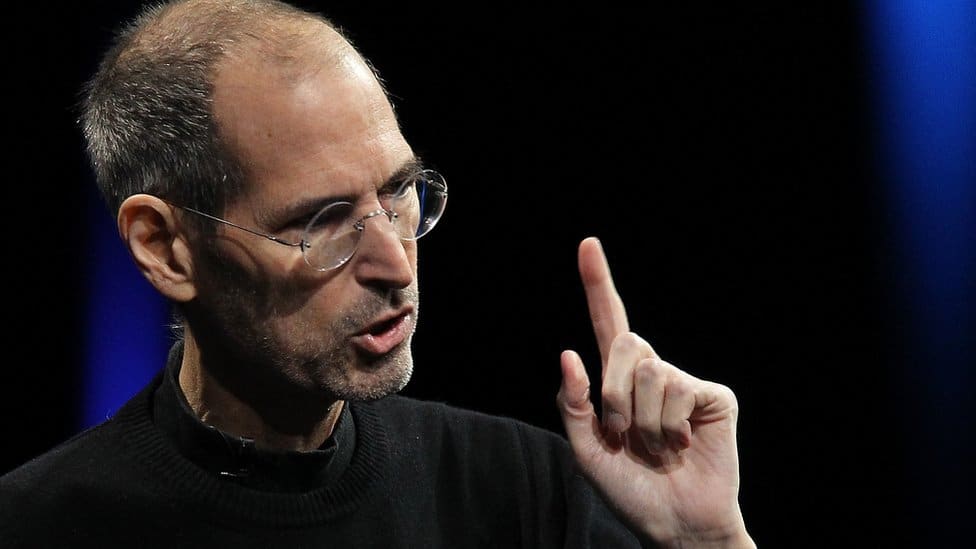
When the project got the green light, Steve was clearly excited. He shared the news with us at one of our regular agency meetings. He was especially thrilled that the role of himself was going to be played by Noah Wyle. At the time, Noah was flying high as part of the cast of the hit show ER.

As one might expect, the movie didn’t make Steve out to be the world’s nicest guy. One particularly bad moment was based on a story that’s floated around for years. The scene took place one day when Steve walked into a room where a job candidate was being interviewed. Steve immediately pegged hinm as an IBM-type and then, for whatever reason, blindsided him with the question “Are you a virgin?” Even worse, he kept pounding away at it, making the candidate more and more uncomfortable. At least this was the way it played out in the movie.

Some months later, preparations were underway for the next Macworld show, which was to be held in the NY Javits Center. One night, Steve called and told me he had a great idea for a way to open the show. He was going to get Noah Wyle to walk on stage and pretend to be him.

Steve had the physical part all figured out — he’d give Noah the black turtleneck, gray New Balances, even duplicate glasses from his personal eyeglass-maker. What he wanted from me was a script. What exactly should Noah say when he walks onstage? How would Steve join in?

I sent a script to Steve the following day. He liked it all, but he was especially fond of the ending. In the script, Steve would thank Noah for coming to Macworld, Noah would walk off stage to applause, but then stop as if he were suddenly remembering something. He’d then turn back to Steve to ask one final question: “Oh, Steve. Are you still a virgin?”

Steve didn’t make a single change to the script, but he did have one question: should it be “Are you a virgin” or “Are you still a virgin”?

“Hey, I don’t know,” I replied. “You’re the one who said it! What exactly did you say?”

Steve’s response surprised me. “No, that’s just it. I never said anything. This never happened — it’s all made up.”

So there you have it. It was all a lie. Granted, Steve wasn’t exactly under oath when he offered this testimony, but he did deny it emphatically. Maybe one day we’ll get a rebuttal from an eyewitness to the event.

Epilogue: We ended up going with “Are you still a virgin,” even though it didn’t exactly match the movie version. And one thing we learned by watching Steve’s performance — although the man was a genuine visionary, his acting skills left a bit to be desired.